By Damian
There are places that exist beyond geography.
Places that cannot be located by satellite, reached by train, or pinned on a digital map. They emerge instead through emotional coordinates. Through longing. Through memory. Through those rare moments when the noise of life recedes just enough for a person to hear the echo of who they might have been.
The Museum of Unlived Lives is one such place.
It exists in the vast psychological architecture hidden beneath human consciousness, tucked somewhere between nostalgia and imagination. It is not built from stone or steel but from abandoned timelines. Every corridor is constructed from unrealized potential. Every staircase ascends through forgotten ambitions. Every room contains a life that once stood within reach before vanishing into the fog of decision.
Most people spend their lives unknowingly carrying the key.
They discover it only during moments of rupture.
A marriage ending after decades. A birthday arriving with alarming speed. The passing of a loved one. An old photograph falling from a drawer. The realization that ten years have passed since a dream was quietly postponed.
These moments create cracks in reality.
And through those cracks, the museum reveals itself.
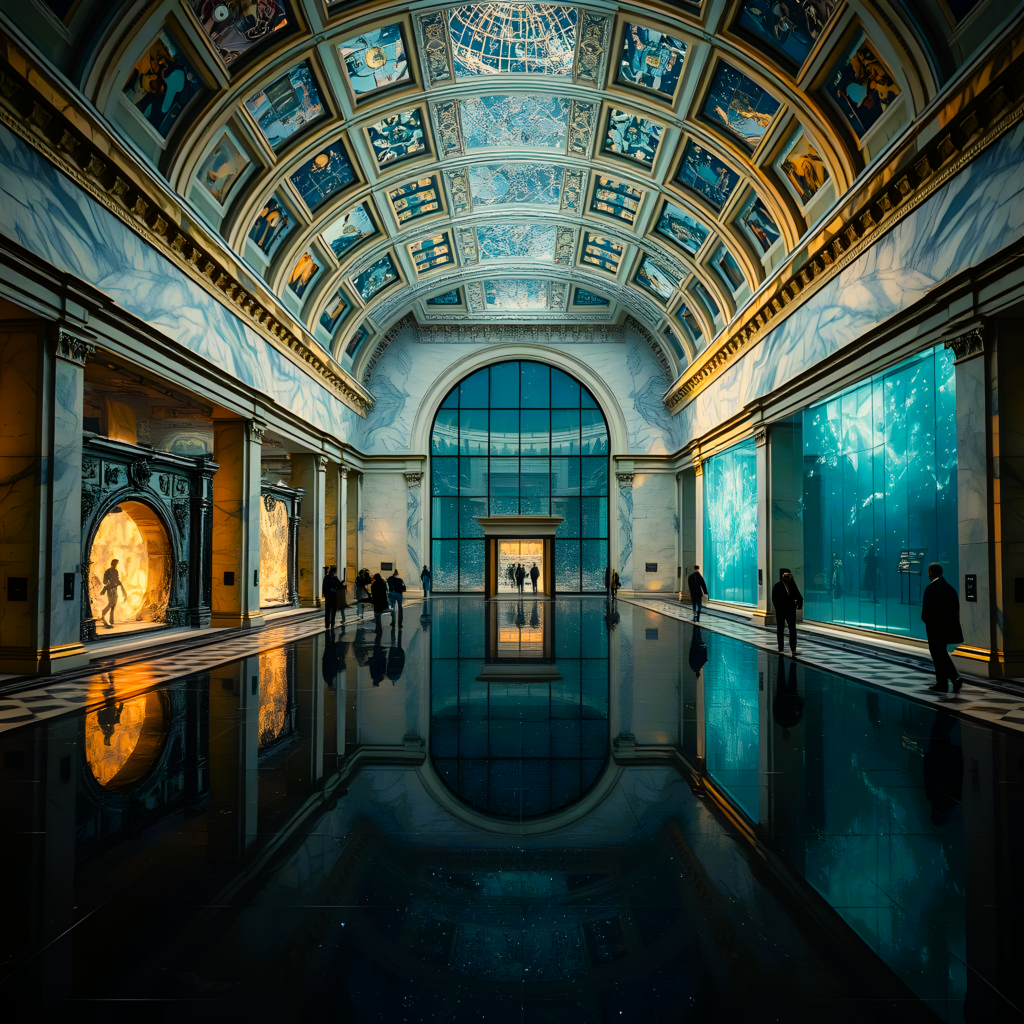
Its entrance resembles neither heaven nor hell. It is something far more intimate. Vast marble halls stretch endlessly beneath ceilings painted with constellations that never existed. Chandeliers hang like frozen galaxies above polished black floors that reflect not your face but fragments of your history. The air carries a strange silence, the kind found in ancient libraries and abandoned cathedrals.
Visitors enter believing they are there to examine the past.
What they discover is something far more unsettling.
The museum is not about what happened.
It is about what did not.
The first galleries often appear deceptively beautiful.
Behind immense panes of glass exist entire alternate realities. Not symbolic representations. Not artistic interpretations. Lives. Fully formed and endlessly unfolding. Each exhibit contains a version of someone shaped by a different decision, a different risk, a different act of courage or hesitation.
In one room, a woman who never gave up on her manuscript sits overlooking the Mediterranean Sea. Shelves behind her are filled with novels bearing her name. The literary world knows her voice. Readers across continents carry fragments of her imagination inside them. Yet the exhibit label reveals something devastatingly simple.
The difference between her life and reality was one decision.
She submitted the manuscript one more time.
Across the hall stands a man performing music before thousands. His movements possess the confidence of someone who belongs on stage. The audience sings every word back to him. Yet visitors learn that his entire future emerged from a single evening when he chose not to convince himself he was too old to begin.
Further down the corridor are scientists, painters, architects, philosophers, explorers, inventors, and lovers. Entire universes generated by seemingly insignificant choices.
A conversation accepted. A flight boarded. A fear ignored. A door opened.
History, the museum suggests, is not shaped by monumental moments alone. It is shaped by the microscopic decisions that appear meaningless while they are happening.
The human tendency is to view destiny as a thunderstorm.
The museum reveals it is often a drifting snowflake.
Soft.
Silent.
Transformative.
Yet the deeper one travels into the museum, the more uncomfortable the experience becomes.
Because the exhibits refuse to indulge fantasy.
Visitors arrive expecting to discover perfect lives hidden beyond missed opportunities. They imagine alternate realities as polished masterpieces untouched by hardship. The mind has always romanticized the roads it never traveled. Every abandoned future becomes bathed in golden light precisely because it was never forced to endure reality.
The museum dismantles this illusion with surgical precision.
The famous filmmaker who achieved international acclaim lives beneath crushing isolation. The entrepreneur who built a billion-pound empire forfeited relationships that never returned. The acclaimed philosopher spent decades wrestling with an internal emptiness that success could not reach.
Even the most radiant exhibits contain shadows.
Every life includes sacrifice.
Every achievement demands payment.
Every version of happiness arrives carrying its own species of grief.
One gallery is particularly famous among visitors.
The Hall of Perfect Choices.
People enter hoping to find answers. Validation. Proof that somewhere among infinite possibilities exists the one path that would have solved everything.
Instead they encounter a nearly empty room.
At its centre stands a single inscription.
There was never only one way to become yourself.
The revelation lands with tremendous force.
Human beings often torture themselves with the belief that a single wrong decision destroyed their future. They imagine life as a narrow bridge suspended above catastrophe. One misstep and everything collapses.
The museum proposes a different possibility.
Most paths contain joy.
Most paths contain suffering.
Most paths contain beauty.
Most paths contain disappointment.
A different life is not necessarily a better life. It is simply another expression of being human. For many visitors, this realization feels less like comfort and more like an earthquake.
Beyond the Hall of Perfect Choices lies the museum’s most haunting section.
The Gallery of Small Abandonments.
There are no dramatic tragedies here. No failed empires. No lost fortunes. No life-altering catastrophes.
Instead, visitors encounter display after display containing tiny neglected moments.
The sketchbook never opened. The language never learned. The apology never spoken.
The morning walks repeatedly delayed. The guitar gathering dust in the corner. The book remaining forever trapped inside someone’s mind.
The exhibits feel painfully ordinary.
That is precisely why they are devastating.
Civilization teaches people to fear spectacular failure. The museum understands a darker truth. Most dreams do not die through destruction.
They die through erosion.
One postponed day becomes one postponed year.
One postponed year becomes an entire identity quietly disappearing beneath routine.
The gallery stretches endlessly.
Visitors walk through it with growing unease because they recognize themselves in every glass case.
They realize the greatest losses of their lives may not be dramatic enough to become stories.
Only absences.
Only silences.
Only possibilities that slowly starved.
At the centre of the museum exists a chamber unlike any other.
Its unofficial name is Damian’s Room.
No one knows who Damian was.
Some believe he was the architect of the museum. Others believe he represents every visitor simultaneously. A symbolic figure standing at the intersection of identity and potential.
The room contains no wealth, fame, or accomplishments.
Only versions.
Hundreds of them.
Thousands.
Each Damian embodies a different aspect of existence.
One pursued beauty with obsessive devotion and became an artist whose work transformed generations. One pursued knowledge until his thoughts became cathedrals. One chose love over ambition and built a life so rich in intimacy that achievement became irrelevant.
One sought power and obtained it, only to discover control is a poor substitute for meaning. One vanished into forests and mountains, abandoning civilization entirely.
One became a philosopher.
One became a father.
One became a stranger to himself.
They stand together beneath a vast domed ceiling filled with stars, staring outward through the glass.
Not as competitors.
Not as failures.
Not as superior alternatives.
As fragments.
Possibilities.
Ghosts.
The room presents a terrifying idea. Perhaps identity is not a single self waiting to be discovered. Perhaps identity is a graveyard. To become one person requires the sacrifice of countless others.
Every choice is simultaneously an act of creation and an act of mourning. The person you are today exists because thousands of possible selves never received permission to live.
The artist died so the lawyer could survive. The traveler died so the parent could emerge. The dreamer died so the realist could function.
The museum understands something modern culture desperately avoids.
Transformation is not only birth.
It is burial.
Near the exit stands the final exhibit.
Unlike every other display, there is no glass separating the visitor from what they see.
No barrier.
No protective distance.
Only a mirror.
At first it appears ordinary.
Then the reflection changes.
Not dramatically.
Subtly.
Painfully.
The face staring back becomes an evolving mosaic of unrealized futures. Versions of yourself emerge and disappear like reflections on dark water. Some appear happier. Some appear wiser. Some appear broken. Some appear extraordinary. Others appear wonderfully ordinary.
For a moment, all of them exist together.
Every abandoned ambition.
Every unlived romance.
Every unwritten chapter.
Every dormant possibility.
Every self that could have been.
Then beneath the reflection, a final inscription appears.
None of them are waiting for you.
Most visitors expect the sentence to continue.
It does not.
Because that is the lesson.
The museum was never designed to inspire regret.
It exists to dismantle it.
Those lives are not hidden treasures stolen by fate. They are not better realities trapped behind invisible walls. They are not evidence that your current existence is a mistake.
They are reminders.
Reminders that possibility has always surrounded you. Reminders that identity is fluid. Reminders that becoming is not finished.
The future, unlike the exhibits, remains unwritten.
And perhaps that is the greatest artwork within the entire museum.
Not the lives that were lost. Not the lives that never happened. But the life still unfolding beyond the exit doors.
The one standing here now. The one holding the key. The one with corridors still waiting to be built.